Self-Assessment
My Self-Analysis
I found myself in a dilemma when I realized that the next few essays I would find myself writing would revolve around the concept of language. Writing about the way that I write throws my mind in a spiral, leading me to genuinely dig deeper into my identity. I don’t like talking about my identity but I am grateful for picking up the concepts connected to language because these modern times have made many of us blind to how we were meant to write. The way we write is meant to mirror the way we speak and vice-versa, thus my most significant learning throughout this chaotic semester was that because of Standard English our authenticity begins to diminish in ways we are unaware of.
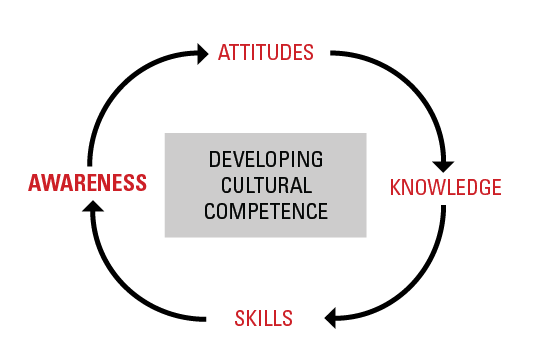
Unintentionally or not, the education system tends to be liable for throwing the youth into the trap of Standard English. To specify, teachers who teach English starting from elementary school enforce only one type of English and that is “Standard English”. This may seem normal because it allows them to have a chance to attend college but on a psychological level, it causes students to write and speak in an unoriginal way. I coined this understanding through the words of Vershan Ashanti Young in his argumentative essay Should Writers Use they Own English, specifically when he sheds light on the fact that students are penalized for using their dialect in class or in a professional setting. He instead promotes the idea that “everybody mix the dialect they learn at home with the dialect they learn at school” (Young) so that they create a newer culturally aware English that doesn’t critique. I dove deep with this learning especially when I brainstormed ideas for my Synthesis Essay and although I never used it in the end it did push me to a newer realization I placed in my essay. To me, Young’s essay resonated well with the concept of cultural competence which was a strong point in my essay and it allowed me to dive deeper into the perspective of the professor.
Stories that revolve around the concept of language and literacy tend to involve many different languages. Some of the presentations from my peers from our Translation 1 assignment highlighted the fact that they had to teach or translate a certain language to English or vice-versa.
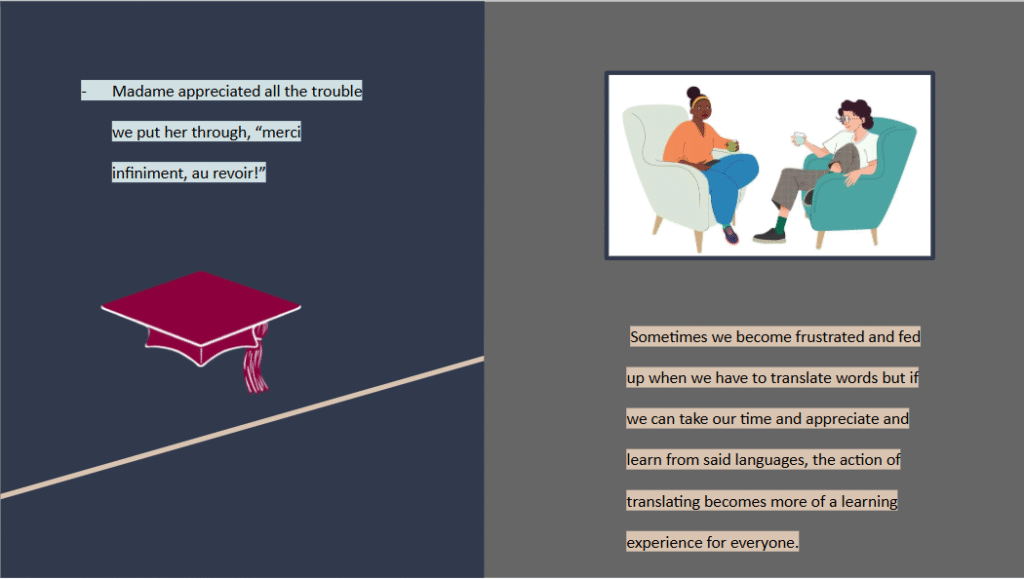
In other words, some of my peers were involved in situations where someone they knew needed assistance in understanding the English language and had to rely on someone for help. I too was involved in a situation such as this which led to the development of my LLN essay Foundations In French, focusing on the relation I had with my French teacher in high school. For example, me and my classmates had to help her translate certain words while we picked up the french words she taught us, “While we aided in her translating words correctly we also decided to teach her recent common slang such as “you fire” or “lock in” which in return she would teach us French slang and some “bad” words along the way.”The insight I gained from writing the essay was that I understood that people tend to give up easily when translating languages because at times the languages they are attempting to translate could be ones they are currently learning or not fully proficient in. I was also able to decipher the fact that language and literacy is a major part in the lives of U.S. immigrants or children of immigrants because of the fact that they are expected to be in touch with the English language to get where they want to be in the American dream.
Making your point doesn’t always have to involve your writing. Although this claim may have nothing to do with Standard English or language, it was probably one of the most impactful assets I’ve begun to add to many of my essays. I noticed the format when I flipped through the syllabus of the course on the first day and it was reinforced for the following months. Despite taking a nap during our first lecture, it was my first time seeing this format and when it was used in actual writing I was ecstatic because I was taught that pictures in writing aren’t formal. When I got the chance to implement this technique in my Synthesis Essay and my Translation 2 assignment I took my time and deciphered the pictures and gifs I chose so my audience would be able to understand my message.
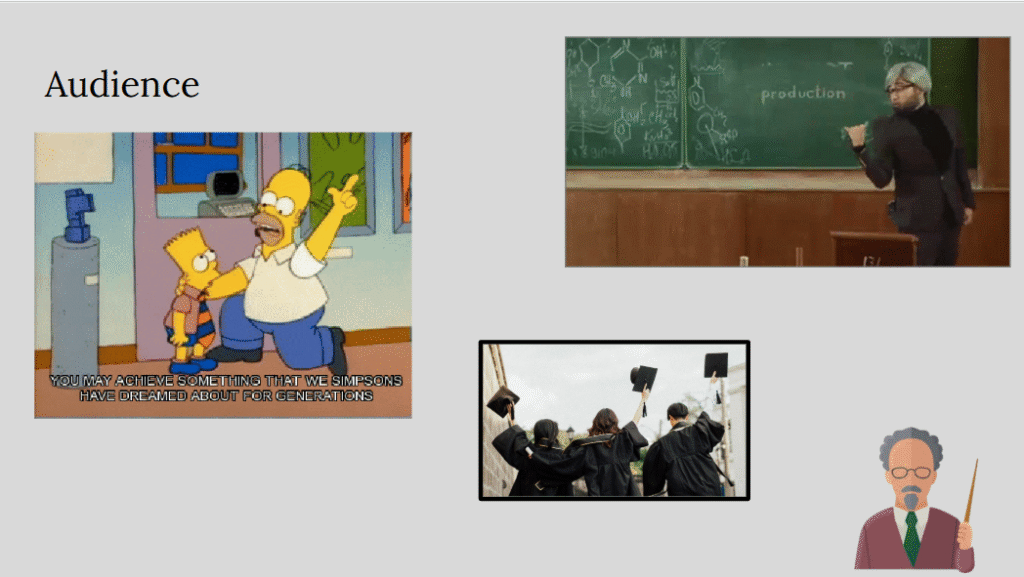
We alter the way we talk when our audience changes. To put it another way, our language changes based on the relationship we have with a person. For example you would talk with a friend in a more lax tone but talking with your manager at a new job would cause you to change the tone to something more serious. When I was told in class to write about a situation that I would need to tell my friend and my neighbor, I found that the story I told my neighbor was a lot more serious and formal than the story I told my friend. I had even left out details when I told the neighbor about the story, in fear of being judged in a way I didn’t like. This made me want to find level ground with the words I use so I could communicate the same story to any audience without having to leave or add details. It initially seemed difficult but when my LLN essay was being revised by my professor I was communicating in a lax way, conversing in my tone, my language. After I wrapped up the 1 on 1 revision I felt more comfortable with talking with my professors and people I didn’t really know. This experience resonated with me the most because I tend to be a bit shy and don’t speak unless spoken when my friends aren’t around, but began talking with some more confidence within some of my classes.

This took effect strongly when it came to my Translation 2 because I made sure it was purely pictures and gifs and no words at all. This led me to the next step which was mixing in pictures and words to lay down a message that I believed anyone could understand no matter the age difference. Overall I really liked picking up the strategy because I began to feel like my writing was boring and had no “umph” to it.
In essence, I initially thought that this class would be another boring English class, however the semester taught me concepts about myself I did not want to indulge in. It opened up a newer level of understanding where I can genuinely know how I speak and communicate which I am now cherishing.

This entry is licensed under a Creative Commons Attribution-NonCommercial-ShareAlike 4.0 International license.

